


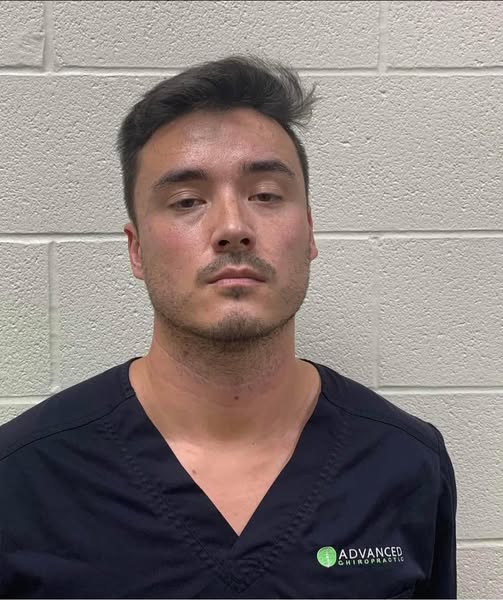
Brian Thomas Mann was a chiropractor, husband and father living in northern Alabama when his wife, Hannah Pettey, began suffering from an unexplained illness that left her close to death.
For months, Hannah experienced severe abdominal and back pain, nausea, vomiting, weight loss and weakness. By January 2022, she could barely walk. Doctors at the University of Alabama at Birmingham eventually discovered that her body contained an extraordinary amount of lead.
What began as a medical mystery became an attempted-murder investigation.
Prosecutors accused Mann of using his access to lead at his chiropractic office to create poisoned capsules that he supplied to his wife as supplements. They argued that he had been trying to kill Hannah over a period of months while holding life-insurance policies that could have produced a substantial payout if she died.
Mann denied poisoning her and maintained his innocence through the investigation and trial.
A Morgan County jury rejected his defense in June 2025 and found him guilty of attempted murder. Mann was sentenced to life in prison two months later.
His effort to overturn that conviction failed. In June 2026, the Alabama Court of Criminal Appeals upheld both his conviction and life sentence.
- “The Gaslighting of Hannah Pettey”: 48 Hours Reports September 5 2026
- Who Is Hannah Pettey & Where Is She Now? 2026 Update & Profile
Brian Mann Worked as a Chiropractor in Alabama
Before his arrest, Brian Thomas Mann operated a chiropractic practice in the Decatur and Hartselle area of Alabama.
His occupation became important to the criminal case because the practice contained an X-ray room.
X-ray rooms require shielding to prevent radiation exposure outside the room. At Mann’s office, contractors had installed sheets of soft lead inside the walls as part of that shielding.
Years later, prosecutors would argue that those sheets supplied Mann with the substance he used to poison his wife.
The prosecution did not establish that Mann had unusual access to a rare material. Lead was present at his workplace for a legitimate reason.
The significance was that he knew it was there and, according to a contractor who had performed the work, was left with excess material after the construction project.
Mann Met Hannah Pettey When She Was 18
Hannah Pettey was 18 when she met Mann.
Mann was about 11 years older and was already established in his profession.
Their relationship developed fast.
According to Hannah and people who knew the couple, Mann presented himself as attentive and charming during the early stages of the relationship.
A friend of Mann’s recalled that he described Hannah as “the one” soon after they began dating.
Hannah became pregnant, and the couple moved toward marriage.
Mann proposed after they had been dating for only a few months.
They married in May 2018.
Brian and Hannah Had Two Children
The couple had two children, a son and a daughter.
To people outside the marriage, Mann could appear to have built a conventional family life around his chiropractic career.
Hannah later described a more complicated relationship.
She told 48 Hours that Mann could be a good husband but also described controlling behaviour and physical fights.
She acknowledged that she had a tendency during the marriage to minimise some of those incidents.
The couple’s family life became one of the factors that made Hannah struggle to accept the accusation against Mann once police began investigating him.
He was not a stranger suspected of poisoning her.
He was her husband and the father of her children.
Mann Had a Bitter Relationship With Hannah’s Mother
Brian Mann and Hannah’s mother, Nicole Pettey, had a poor relationship.
Nicole said Mann avoided her and did not participate in family gatherings involving her.
She claimed that when she visited Hannah, she had to do so while Mann was working and leave before he returned home.
Mann gave a different account.
He portrayed Nicole as critical and controlling toward Hannah and said she caused problems within the marriage.
This hostility became a major part of the poisoning investigation.
When doctors said someone appeared to be trying to kill Hannah, Mann began suggesting that Nicole could be responsible or that she was manipulating the investigation against him.
Police initially had to consider both possibilities.
Hannah Began Becoming Sick in 2021
During 2021, Hannah developed a series of unexplained health problems.
Her symptoms included severe abdominal and back pain, nausea, vomiting and loss of strength.
She lost a large amount of weight.
Doctors struggled to determine the cause.
As Hannah became weaker, Mann was one of the people closest to her and had constant access to her daily routines.
Hannah later recalled that Mann supplied her with vitamins and supplements.
He would leave capsules on her nightstand for her to take.
At the time, she had little reason to consider that suspicious.
Her husband worked in health care.
Prosecutors Said Mann Used Vitamins to Deliver the Poison
The prosecution eventually developed a theory that Mann had opened supplement capsules and placed small pieces of lead inside them.
Hannah then swallowed the capsules while believing she was taking vitamins.
This method would have allowed the poisoning to continue over time without requiring Mann to place something noticeable into food or drink.
Hannah testified about one night when she was in severe pain and felt too nauseated to take the pills Mann had left for her.
She said Mann became upset and insisted that she take them.
For prosecutors, the incident helped support their theory that the supplements were not an incidental part of Hannah’s routine.
They were the delivery method.
Hannah Became Too Weak to Walk
By January 2022, Hannah’s physical deterioration had become severe.
She was spending long periods in bed.
She became so weak that she used an office chair to move around her house.
She continued trying to care for her young children despite her condition.
Hannah was too sick to attend her daughter’s second birthday party.
Her mother became concerned after speaking with her by telephone on January 18.
Hannah could barely communicate.
She asked Nicole to take her to the hospital.
Nicole drove her to UAB Hospital in Birmingham.
Hannah Nearly Died at the Hospital
At the hospital, Hannah suffered a major seizure.
She lost consciousness.
Doctors concluded that her condition was far worse than her family understood.
Nicole recalled being told that Hannah was starving to death and might have had only hours to live.
Hannah remained unconscious for an extended period and later developed dangerous pressure and fluid around her brain.
Doctors placed her into a medically induced coma.
At one stage, medical staff feared that even if Hannah survived, she might suffer major neurological damage.
Then testing identified the cause.
Doctors Found Lead Throughout Hannah’s Body
Doctors discovered a massive amount of lead in Hannah’s system.
Medical imaging showed material throughout her digestive tract.
Her blood and bones also contained lead.
The level was severe enough to explain the neurological symptoms, pain, weight loss and collapse that had developed over the preceding months.
Doctors concluded that the exposure was not consistent with a routine environmental source.
Someone appeared to have been giving Hannah lead.
The hospital reported the case to authorities.
A medical emergency became a suspected attempted murder.
Mann Became a Suspect
Investigators began reconstructing what Hannah had consumed before her hospitalization.
The supplements provided by Mann attracted attention.
Police asked what medications and vitamins she had taken and searched the family home.
Mann initially cooperated.
He allowed investigators to examine the property and provided items that Hannah had used.
Tests did not produce the evidence police hoped to find.
No lead-filled capsule was recovered.
No contaminated supplement was found.
Investigators discovered no evidence of lead being processed inside the family home.
That absence would later become central to Mann’s defense.
Mann Suggested Hannah’s Mother Was Responsible
Mann told investigators that he believed Nicole was responsible for creating the accusations against him.
His distrust of his mother-in-law was not new.
He described her as a destructive force in Hannah’s life and portrayed the investigation as another example of her interference.
Police investigated Nicole as well.
She was eventually cleared.
Investigators concluded she lacked the type of continuous access that would have been required to account for Hannah’s prolonged poisoning.
Attention shifted back toward Mann.
The case, however, still lacked a direct physical connection between him and a source of lead.
Mann Was Also Found to Have Lead in His Body
The investigation produced another unusual development.
After police asked whether Mann and the children had also been tested, Mann underwent medical examination.
An X-ray showed lead inside his body.
Investigators did not accept this as proof that someone had been poisoning the entire family.
Court documents said a medical professional believed the lead in Mann had been ingested within a short period.
Investigators developed the theory that Mann had consumed lead after suspicion fell on him in an attempt to make it appear that he too was a poisoning victim.
That allegation became another part of the state’s interpretation of his conduct.
Investigators Found a Possible Financial Motive
Police discovered that Mann held substantial life-insurance coverage on Hannah.
Trial testimony showed five policies across four insurers with Mann listed as the primary beneficiary.
Those policies totalled about $1.3 million, according to testimony reported during the trial. Hannah said she had never seen the policies, while the defense pointed out that her signatures appeared on them. An insurance agent testified that the signatures had been completed electronically.
The broader investigation also examined additional insurance applications made while Hannah was critically ill.
Prosecutors viewed the policies as the clearest explanation for motive.
If Hannah died, Mann stood to receive money.
Their theory was that a prolonged poisoning could make her death resemble the result of an illness rather than homicide.
A Contractor Connected Mann to a Source of Lead
The investigation changed when contractor Danny Hill contacted police.
Hill had worked on the X-ray room at Mann’s chiropractic office.
He explained that sheets of soft lead had been installed inside the walls for radiation protection.
The material could be scraped into small pieces.
Hill demonstrated that the shavings were small enough to fit inside an empty capsule.
He also remembered asking Mann what should be done with lead left over after construction.
According to Hill, Mann said he would take care of it.
The information gave investigators something they had lacked: evidence that Mann had access to a form of lead that could have been placed into capsules.
Police Searched Mann’s Chiropractic Office
Investigators obtained a search warrant.
Police removed part of the wall from the X-ray room and recovered sections of lead sheeting.
The discovery strengthened the prosecution’s circumstantial case.
It did not solve every evidentiary problem.
Police did not establish through forensic testing that the lead recovered from Hannah’s body came from the exact sheet inside Mann’s office.
During the trial, the defense highlighted that gap.
Evidence obtained from Hannah’s body had been retained in an effort to compare it with the office lead, but investigators had not been able to obtain the forensic testing necessary to make such a match.
Prosecutors argued that the absence of a laboratory match did not erase the other evidence.
Brian Mann Was Arrested in September 2022
A Morgan County grand jury indicted Mann.
He was arrested on September 2, 2022, and charged with attempted murder.
Mann pleaded not guilty.
For much of the period before trial, he remained free on bond under restrictions.
At one stage, the conditions required him to report to the Morgan County Jail each weekend.
He later wore a GPS ankle monitor instead.
Mann continued denying that he had poisoned Hannah.
His lawyers challenged aspects of the investigation, the handling of evidence and the prosecution’s theory.
The case took almost three years to reach a jury.
Mann Went on Trial in June 2025
The trial began in Morgan County in June 2025.
Prosecutors had no eyewitness who had seen Mann put lead into a capsule.
They had no poisoned capsule.
They had no confession.
Their case was circumstantial.
They presented Hannah’s medical records and X-rays, her testimony about the supplements, Mann’s access to lead at his office, the life-insurance evidence and the circumstances of the couple’s relationship.
The defense attacked each link.
Attorney Chad Morgan argued that proving Hannah had been poisoned was not the same as proving Brian Mann had poisoned her.
Mann’s Lawyers Said the State Could Not Prove the Source of the Lead
The lack of forensic comparison became one of the defense’s strongest arguments.
Police had recovered lead from Mann’s office.
They had also obtained material associated with the lead found in Hannah.
But no scientific test presented to the jury established that the two sources matched.
The defense argued that this left a major gap in the prosecution’s theory.
Mann’s lawyers also questioned how some evidence had been collected and sought to prevent certain lead evidence from being presented to the jury.
The judge permitted the case to proceed.
The prosecution argued that criminal guilt could be proven through a combination of circumstances even without a direct scientific match.
The Defense Tried to Shift Suspicion Toward Nicole
Mann’s defense also raised the possibility that Hannah’s mother was responsible.
Attorney Chad Morgan suggested Nicole could have given Hannah milkshakes containing lead.
Hannah disputed the account.
She said she did not recall receiving the milkshakes and did not like them.
Prosecutors argued that Nicole lacked the repeated access necessary to explain months of poisoning.
By contrast, Mann lived with Hannah and was the person she said was supplying her supplements.
The competing theories gave jurors a clear choice.
Either prosecutors had constructed the correct explanation from circumstantial evidence, or they were blaming the wrong person for a poisoning whose delivery method had never been directly observed.
The Defense Called No Witnesses
After the prosecution presented seven witnesses, Mann’s attorneys rested without calling anyone.
That did not mean Mann was required to prove his innocence.
Under criminal law, the burden remained with prosecutors.
The defense strategy was to argue that the prosecution had failed to meet that burden.
Mann did not testify.
His attorney argued during closing statements that the state had not shown anyone seeing Mann prepare, handle or administer a lead-filled pill.
Prosecutors asked jurors to consider the complete pattern rather than each piece in isolation.
The jury began deliberating.
Brian Mann Was Found Guilty
On June 12, 2025, the jury returned its verdict.
Brian Thomas Mann was found guilty of attempted murder.
Hannah and members of both families became emotional as the verdict was announced.
Hannah later said Mann looked toward her when the decision was read and that she had to leave the courtroom because of her reaction.
The verdict meant jurors accepted the state’s circumstantial case.
Under that verdict, Mann had spent months poisoning his wife with lead while she believed she was suffering from an unexplained illness.
The case moved to sentencing.
Mann Was Sentenced to Life in Prison
On August 27, 2025, Brian Mann appeared before Morgan County Circuit Judge Charles Elliott.
The prosecution argued that the crime was not a momentary act.
Their case described repeated decisions to administer poison over time while watching Hannah become weaker.
Judge Elliott sentenced Mann to life imprisonment with the possibility of parole.
The judge also made clear that he opposed Mann’s future release.
He asked prosecutors to inform him if Mann ever became eligible for parole so that he could appear and argue against it.
Mann did not make a statement at sentencing.
Mann Tried to Obtain a New Trial
After sentencing, Mann’s attorneys sought to overturn the verdict.
They filed a motion for acquittal and a new trial.
The defense maintained that prosecutors had proved Hannah suffered from lead poisoning but had not proven beyond a reasonable doubt how she ingested it or that Mann was the person responsible.
The trial judge rejected those arguments.
The motion for a new trial was denied in October 2025.
Mann then pursued an appeal.
His case moved to the Alabama Court of Criminal Appeals.
His Conviction Was Upheld in 2026
The appellate challenge did not result in a new trial.
On June 18, 2026, the Alabama Court of Criminal Appeals affirmed Brian Mann’s attempted-murder conviction.
The court also left his life sentence in place.
The decision represented another major defeat for Mann’s effort to overturn the jury’s verdict.
As of September 2026, the conviction therefore remains intact.
He is a convicted attempted murderer serving a life sentence.
Where Is Brian Thomas Mann Now?
Brian Thomas Mann is currently incarcerated at Limestone Correctional Facility in Alabama.
After sentencing, Mann passed through Alabama’s prison system. Reporting from January 2026 placed him at Kilby Correctional Facility, which serves as an intake and processing institution for male prisoners.
By June 2026, after the Alabama Court of Criminal Appeals affirmed his conviction, authorities confirmed that Mann was serving his sentence at Limestone Correctional Facility.
He remains under a life sentence with the possibility of parole.
His conviction has not been overturned.
Brian Mann Went From Chiropractor to Life Prisoner
Before the investigation, Mann had a chiropractic practice, a wife, two children and a professional position that placed him in contact with patients seeking health care.
By 2025, he was standing in a courtroom convicted of trying to kill his wife.
The prosecution case relied on a method that left little conventional evidence.
No gun was fired.
No knife was recovered.
There was no single moment of attack witnessed by another person.
Instead, Hannah became weaker over months as lead accumulated inside her body.
Prosecutors convinced the jury that Mann had exploited one of the most ordinary parts of their household routine: a husband giving his wife supplements.
What Happened to Brian Thomas Mann?
Brian Thomas Mann’s legal outcome is now clear.
He was convicted of attempted murder on June 12, 2025.
He was sentenced to life imprisonment with the possibility of parole on August 27, 2025.
His request for a new trial was denied.
His conviction and sentence were affirmed by the Alabama Court of Criminal Appeals on June 18, 2026.
He is now incarcerated at Limestone Correctional Facility.
The chiropractor who once supplied Hannah with what she believed were vitamins is now serving a life sentence because a jury concluded those capsules were part of his attempt to kill her.
Hannah survived.
Mann went to prison.
More “The Gaslighting of Hannah Pettey”
- “The Gaslighting of Hannah Pettey”: 48 Hours Reports September 5 2026
- Who Is Hannah Pettey & Where Is She Now? 2026 Update & Profile
- Who Is Brian Thomas Mann & Where Is He Now? 2026 Update & Profile
More Feature Articles
- “The Grudge”: Dateline NBC Revisits the Murder of Daniel Anderl and the Gunman Who Targeted Judge Esther Salas September 4 2026
- “The Hungryland Homicide”: 20/20 Reports on Tricia Todd Homicide September 4 2026
- “The Gaslighting of Hannah Pettey”: 48 Hours Reports September 5 2026
- “Tracker Dakota Black”: 48 Hours Reports on Makayla Meave Homicide September 5 2026