


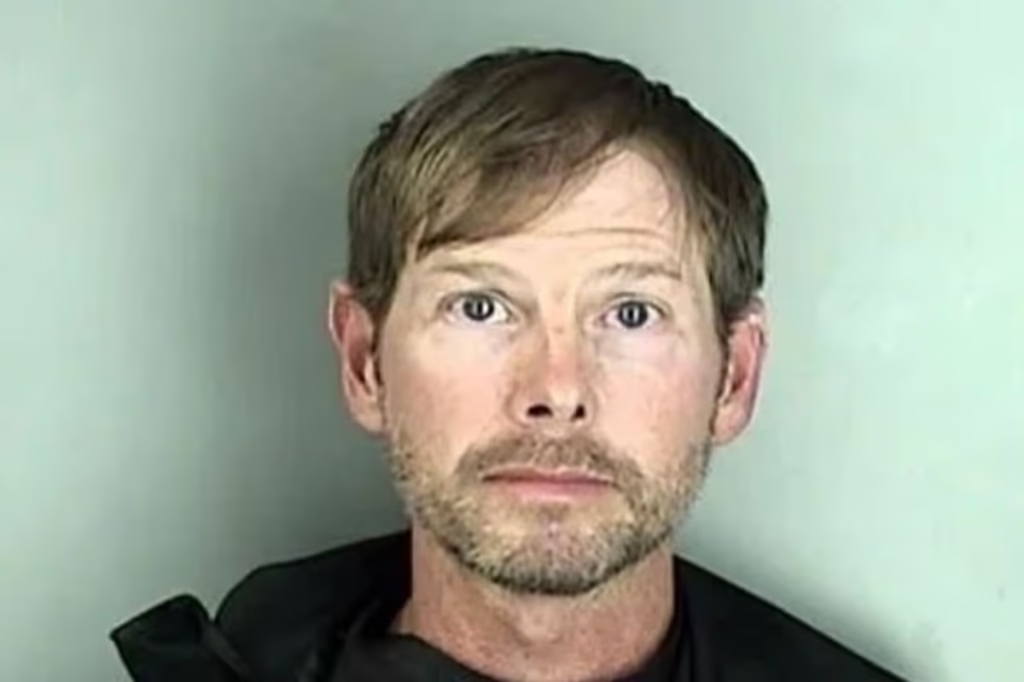
William Grey “Bud” Ackerman was a Greenwood, South Carolina, businessman whose marriage to Meredith Haynie and anger over her new relationship became central to the murder case involving Davis McClendon. On May 7, 2023, Ackerman struck and killed 46-year-old McClendon with his Ford F-250 after the two men arranged to meet on a secluded Greenwood road.
Ackerman maintained that McClendon’s death was an accident. Prosecutors argued that Ackerman had spent hours searching for his estranged wife and McClendon before using his pickup truck as a weapon. In September 2024, a jury rejected Ackerman’s explanation and convicted him of murder. He was sentenced to 45 years in prison without eligibility for parole.
- “The Hit-and-Run Homicide of Davis McClendon”: 48 Hours Reports on August 22 2026
- Who Was Davis McClendon & What Happened to Him? 2026 Update & Profile
William “Bud” Ackerman Was a Greenwood Business Owner
Before the murder case, Ackerman was a local businessman in Greenwood, South Carolina. He owned an auto body shop and came from a prominent local family. He was married to elementary school teacher Meredith Haynie for about 10 years, and the couple had three children.
Haynie described Ackerman as a good father during much of their relationship. Their marriage, however, deteriorated. She told 48 Hours that stress connected with Ackerman’s work appeared to affect him and that his behavior changed.
According to Haynie, Ackerman began drinking more and became unpredictable at home. She described screaming, profanity and criticism. She said he never physically assaulted her, but she felt threatened by his behavior and said the environment damaged her sense of self.
Meredith Haynie Said Ackerman Became Controlling and Paranoid
Haynie also described behavior that she considered controlling. She told 48 Hours that Ackerman became paranoid and began installing hidden cameras around their property.
One discovery involved a pillow with a hole cut into it and a camera concealed inside. Haynie said she later found other cameras, including one in a dresser facing the couple’s bed, another hidden in a bush outside the home and cameras in the children’s rooms.
The couple separated in spring 2022. Ackerman moved into his parents’ home while he and Haynie worked through their separation, divorce and custody arrangements.
Haynie said Ackerman stopped drinking for a period after the separation and continued attending church with her and their children. She had decided, however, that the marriage was over.
Ackerman Learned Meredith Haynie Was Dating Davis McClendon
Haynie met Davis McClendon in December 2022. Their relationship developed during the following months and became serious.
McClendon was divorced and was described by friends as a devoted father and a man who formed close friendships. He worked at a retirement home and was known among friends for his empathy and generosity.
Haynie and McClendon tried to keep their relationship quiet at first. They sometimes went out of town together rather than spend time together around Greenwood.
That changed as the relationship became more serious. Haynie and McClendon began discussing a future together, including growing old together.
Ackerman learned about the relationship before his divorce from Haynie became final.
Ackerman Asked McClendon to Stay Away From His Estranged Wife
After discovering the relationship, Ackerman contacted McClendon.
He asked McClendon to stop seeing Haynie until the divorce became official. According to Haynie, McClendon considered the request.
Haynie and McClendon decided against it. Haynie believed allowing Ackerman to determine when they could see each other would give him control over their relationship.
The defense later portrayed the situation as a source of legitimate emotional distress for Ackerman. His attorney, Jack Swerling, emphasized that Ackerman and Haynie remained married under South Carolina law.
Prosecutors saw Ackerman’s reaction in a different light. They argued that his inability to accept Haynie’s relationship with another man provided the motive for what happened on May 7, 2023.
Ackerman Spent the Night Trying to Contact Haynie
On May 6, 2023, Haynie and McClendon went to dinner at Break on the Lake.
Phone records showed Ackerman repeatedly attempting to contact Haynie during the evening.
At 8:54 p.m., he sent her a message asking why she hated him and saying that he did not understand. Haynie did not respond.
Ackerman also contacted her through FaceTime and questioned her about where she was and who she was with. Haynie said Ackerman learned that she was with McClendon.
The calls continued as the night progressed.
Investigators would use those communications to argue that Ackerman was focused on finding his estranged wife and the man she was dating.
Security Cameras Recorded Ackerman Moving Around Greenwood
At about 10:40 p.m., Ackerman arrived at the Key West Club in Greenwood.
Surveillance cameras recorded him talking with people and drinking. He remained there for about an hour and a half.
Haynie said Ackerman contacted her again and sounded intoxicated. She described his language as vulgar.
After midnight, Ackerman left Key West. Around half an hour later, security cameras recorded his white Ford F-250 circling the parking lot at Break on the Lake.
Haynie and McClendon had left the restaurant by that point.
Investigators interpreted Ackerman’s movements as evidence that he was searching for them.
Ackerman and McClendon Agreed to Meet
Haynie and McClendon went to the Key West Club after dinner. Ackerman had left by the time they arrived.
At about 12:51 a.m. on May 7, McClendon stepped outside and called Ackerman.
Haynie believed McClendon wanted to reduce the tension between the two men. Several minutes later, she discovered that McClendon had left the club.
McClendon called Haynie and told her that he was going to meet Ackerman.
According to the defense, the original plan was for McClendon to meet Ackerman at the home of Ackerman’s parents, where Ackerman’s children were sleeping.
Defense attorney Jack Swerling said McClendon changed the location to the intersection of Avid Road and Sawgrass Place, about half a mile away.
That secluded intersection became the scene of McClendon’s death.
Ackerman’s Ford F-250 Struck Davis McClendon
There was no dispute at trial that Ackerman was driving the vehicle that killed McClendon.
Investigators determined that Ackerman’s Ford F-250 struck McClendon shortly after 1:11 a.m.
McClendon’s BMW was also struck and suffered major damage.
The prosecution argued that McClendon was standing beside the driver’s side of his BMW when Ackerman approached.
Collision reconstruction evidence indicated that Ackerman’s truck moved onto the wrong side of the road.
Prosecutors argued that Ackerman aimed the truck at McClendon, sideswiped the BMW and struck McClendon. Authorities believed McClendon was carried on the truck’s grille before falling about 50 feet from his car.
The defense agreed that Ackerman struck McClendon but rejected the claim that he did so on purpose.
Ackerman Said He Was Trying to Avoid McClendon
Ackerman’s defense maintained that the encounter was a fatal accident.
According to that version of events, McClendon was standing farther into the roadway than prosecutors claimed.
The road was dark and contained a slope. The defense argued that the headlights of McClendon’s BMW also affected visibility.
Automotive forensics expert Jonathan Nelson testified that Ackerman might have had no more than about two and a half seconds to see McClendon and react.
Ackerman said he jerked his truck to the left when he saw McClendon.
He claimed that he tried to strike the BMW with his truck to stop his forward movement and avoid hitting McClendon.
Prosecutors argued that the physical and digital evidence did not support that explanation.
Ackerman Left Without Calling 911
One of the most significant facts in the case concerned what Ackerman did after hitting McClendon.
He left.
Ackerman did not call 911 or remain with McClendon.
Data recovered from the Ford showed that Ackerman stopped after the collision. Investigators determined that the driver’s door opened before the truck was shifted into park.
The data then showed the door closing and the truck moving again.
Investigators believed Ackerman got out, observed the scene, returned to his truck and drove away.
He turned the damaged pickup around and drove back to his parents’ house.
The Damaged Truck Left an Oil Trail
The collision damaged Ackerman’s F-250 enough to cause it to leak oil.
That oil became one of the most important pieces of evidence in the investigation.
At the collision scene, Greenwood County Sheriff’s investigators found an oil slick. They also saw tire marks and footprints.
The oil continued down the road.
Investigators found oil splattered on a streetlight post near the location where evidence suggested Ackerman turned his truck around.
They followed the trail away from McClendon’s body.
It led to the Ackerman family home.
Deputies Found Ackerman With His Damaged Pickup
When deputies reached the house, Ackerman and his father were outside near the garage.
The white Ford F-250 was in the driveway.
Investigators saw oil leaking from underneath the truck. The grille was damaged, and authorities observed other physical evidence consistent with the collision.
Deputies also found oily footprints leading toward the residence.
Ackerman referred investigators to his attorney.
By about 6:30 a.m. on May 7, 2023, authorities arrested him.
What had started as a suspected hit-and-run was now being investigated as murder.
Ackerman’s Parents Did Not Call 911 Either
Ackerman told his parents what had happened after returning home.
They did not call 911.
That became a significant issue for McClendon’s family and friends and later surfaced during the trial and sentencing.
The defense argued that people can react in unexpected ways during traumatic situations. Ackerman said he panicked.
His father later told the court that he had been disoriented after his son woke him during the early hours and told him about the incident.
For prosecutors, Ackerman’s decision to leave McClendon behind without seeking emergency assistance was part of the evidence surrounding his state of mind after the collision.
Ackerman’s Truck Contained Detailed Digital Evidence
Investigators recovered an unusual source of evidence from Ackerman’s Ford F-250.
Its infotainment system stored extensive information about the operation of the vehicle.
Investigators could examine speed, acceleration, braking, door activity and other events. The system had recorded thousands of individual data points.
The truck also recorded connections with public Wi-Fi networks as Ackerman drove around Greenwood, helping investigators reconstruct where the vehicle had traveled.
The information showed that Ackerman had driven near locations connected to Haynie and McClendon during the hours before McClendon’s death.
It also placed the truck at Avid Road and Sawgrass Place at the critical moment.
The Truck Recorded the Moment of the Fatal Encounter
Investigators identified an event between approximately 1:11:31 and 1:11:32 a.m.
The data indicated that Ackerman was traveling about 25 miles per hour before braking.
The vehicle then recorded the stop and door activity that investigators believed occurred after McClendon had been struck.
For prosecutors, the information was valuable because it provided a digital record independent of Ackerman’s memory or testimony.
Combined with surveillance footage, telephone records and physical evidence, investigators could reconstruct Ackerman’s movements across Greenwood and place him at the scene.
The defense could not argue that another driver had killed McClendon. Its case had to focus on Ackerman’s intent.
Prosecutors Charged Ackerman With Murder
The State of South Carolina accused Ackerman of intentionally using his Ford F-250 to kill McClendon.
Prosecutors argued that jealousy provided the motive.
They pointed to Ackerman’s repeated calls to Haynie, his movements around Greenwood and evidence that he had been looking for Haynie and McClendon.
The state also presented doorbell-camera recordings from near the collision scene.
The recordings captured a vehicle prosecutors identified as Ackerman’s truck. Seconds later, the sound of a collision could be heard.
The recording also contained yelling after the crash.
Prosecutors argued that Ackerman was yelling at the injured McClendon. The defense maintained that the audio was too unclear to establish the words with certainty.
Bud Ackerman Went on Trial in September 2024
Ackerman’s murder trial began in September 2024.
Assistant Attorneys General John Conrad and John Meadors prosecuted the case. Jack Swerling represented Ackerman.
The prosecution’s case combined several forms of evidence.
Jurors heard about Ackerman’s communications with Haynie, security-camera footage showing his movements, the oil trail, damage to both vehicles, collision reconstruction and the data recovered from the F-250.
Meredith Haynie also testified.
She described the breakdown of her marriage, her relationship with McClendon and Ackerman’s repeated attempts to contact her during the hours before the killing.
The Defense Argued There Was No Intent to Kill
Swerling argued that the state could prove a collision but could not prove murder.
He maintained that Ackerman had not gone to the intersection intending to hurt McClendon.
The defense also challenged the state’s portrayal of Ackerman as intoxicated and violent.
Although Haynie said he sounded intoxicated, Swerling noted that officers who encountered Ackerman after the collision did not report that he appeared drunk.
The defense presented expert testimony supporting the argument that Ackerman had little time to react after seeing McClendon in the dark roadway.
Its position was that the collision resulted from poor visibility and an unsuccessful evasive maneuver.
Bud Ackerman Testified in His Own Defense
Ackerman took the witness stand.
He told the jury that he loved Haynie and acknowledged that he was angry about her relationship with McClendon.
He denied intending to hurt McClendon.
Ackerman said the men were supposed to talk. According to his testimony, he approached the meeting location without realizing how fast he was traveling.
He said he did not see McClendon until the last moment.
Ackerman claimed he swerved left and tried to use the BMW to stop the momentum of his truck.
His decision to testify also allowed prosecutors to question him about what happened afterward.
Prosecutors Confronted Ackerman About Leaving the Scene
On cross-examination, Ackerman acknowledged that he never called 911.
He said he panicked.
Instead of remaining at the scene, he drove home and told his parents what had happened.
Prosecutors used that conduct to challenge his account of an innocent accident.
In closing arguments, prosecutor John Meadors described the Ford pickup as Ackerman’s murder weapon and compared the killing to a drive-by shooting carried out with a vehicle rather than a gun.
The state also returned to the infotainment system.
Prosecutors argued that the digital record helped establish Ackerman’s movements and intent.
The defense maintained that prosecutors had not proven malice beyond a reasonable doubt.
The Jury Took Less Than 30 Minutes
After six days of testimony and evidence, the case went to the jury.
The deliberation lasted less than half an hour.
The jury returned a unanimous guilty verdict for murder.
Ackerman’s attorney later said such a fast verdict was a bad sign for the defense and questioned whether jurors had considered all of the evidence.
McClendon’s friends saw the speed of the decision in a different way. They believed the evidence left little room for doubt.
The verdict meant the jury rejected Ackerman’s claim that McClendon’s death resulted from an accident.
Bud Ackerman Was Sentenced to 45 Years
Sentencing followed the guilty verdict.
McClendon’s son, Frederick McClendon, addressed the court and demanded accountability for his father’s death. He also criticized the Ackerman family’s failure to contact authorities after the collision.
Ackerman’s father spoke about why he had not called 911, telling the court that he had been disoriented when his son woke him during the night.
Judge Donald Hocker then sentenced Ackerman to 45 years in the South Carolina Department of Corrections.
The sentence was a major defeat for the defense and meant Ackerman would spend much of the remainder of his life incarcerated.
Where Is Bud Ackerman Now?
Bud Ackerman is serving his 45-year South Carolina prison sentence for the murder of Davis McClendon. He is not eligible for parole under the sentence imposed following his 2024 conviction.
His projected release is 2068, which means he faces decades behind bars unless his conviction or sentence changes through the courts.
Ackerman has appealed his murder conviction. The appeal means his attorneys continue to challenge the result of the criminal case, but the conviction and 45-year sentence remain in effect while that process continues unless a court grants relief.
The case therefore remains active at the appellate level, but Ackerman’s present legal status is that of a convicted murderer serving a lengthy state prison sentence.
Meredith Haynie Is Raising Their Children Without Ackerman
Ackerman’s imprisonment also changed the lives of the three children he shares with Haynie.
Before McClendon’s murder, Ackerman remained involved in their lives under a custody arrangement. He had spent May 6, 2023, with the children at a local festival, and they were sleeping at his parents’ house on the night McClendon died.
Haynie has spoken about trying to protect the children from the consequences of the case while raising them as a single mother.
She said the 45-year sentence gave her some security because she had feared Ackerman could receive a sentence of only several years and return while she was attempting to rebuild her life.
The case left the children facing two losses of different kinds: McClendon was dead, and their father was convicted of killing him and sent to prison for decades.
Ackerman Continues to Maintain the Collision Was Not Murder
At trial, Ackerman never denied that his truck killed Davis McClendon.
His defense centered on what he intended when the collision occurred.
Ackerman testified that he was attempting to avoid McClendon. His attorneys presented expert evidence designed to show that darkness, the road layout and limited reaction time could explain the crash without an intent to kill.
The jury did not accept that explanation.
Instead, jurors accepted the prosecution’s argument that the hours of searching, Ackerman’s emotional state, the collision evidence, the position of his truck and his conduct after striking McClendon demonstrated an intentional killing.
His appeal represents his remaining avenue for challenging that conclusion.
The Murder of Davis McClendon Defines Ackerman’s Current Life
Before May 2023, Bud Ackerman was known in Greenwood as a businessman, husband, father and member of an established local family.
Within hours of McClendon’s death, he became the suspect at the center of a murder investigation.
An oil trail led deputies from McClendon’s damaged BMW to Ackerman’s damaged Ford F-250. Phone records and surveillance footage documented his attempts to find Haynie and McClendon. His own truck supplied investigators with detailed digital evidence about his movements and the moment of impact.
Ackerman insisted he never intended to kill McClendon. A South Carolina jury reached the opposite conclusion in less than 30 minutes.
Today, William Grey “Bud” Ackerman remains incarcerated under a 45-year sentence for the murder of Davis McClendon, with a projected release in 2068. His conviction is under appeal. The man who was once a Greenwood business owner and father living through the end of his marriage now faces decades in prison for the killing that occurred during that separation.
More “The Hit-and-Run Homicide of Davis McClendon”
- “The Hit-and-Run Homicide of Davis McClendon”: 48 Hours Reports on August 22 2026
- Who Was Davis McClendon & What Happened to Him? 2026 Update & Profile
- Who Is Bud Ackerman & Where Is He Now? 2026 Update & Profile
More Feature Articles
- “Baby Holly Found”: 20/20 Reports on Holly Marie Clouse August 21 2026
- “Simply Diabolical”: Dateline NBC Reports on How Michelle Hadley Was Framed in a Cyberstalking Plot August 21 2026
- “The Butterfly”: Dateline NBC Revisits the Homicide of Katelyn Markham August 22 2026
- “The Hit-and-Run Homicide of Davis McClendon”: 48 Hours Reports on August 22 2026
- 60 Minutes Reports on “Ghost Train”, “One Mother’s Story” & Wild Concerto” on August 23 2026