


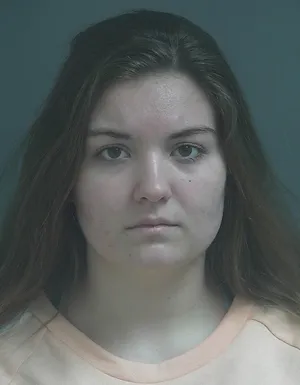
Hannah L. Knapke was just 19 years old when she became entangled in a deadly scheme that led to the murder of Shea Michael Briar. A resident of Fort Recovery, Ohio, Knapke had been a student and athlete at Fort Recovery High School, where she played softball under head coach Esther Jane Stephen. Her connection to Stephen extended beyond the field; court documents and testimony revealed a strong influence the coach exerted over her players, which prosecutors later argued played a role in shaping Knapke’s involvement.
At the time of the murder, Knapke had graduated from high school and was no longer playing. But she remained close to the softball community and to Stephen, who had also enlisted her assistant coach Shelby Hiestand in the same conspiracy. Knapke provided a critical asset: the use of her van, which transported Briar to the rural location where he was ambushed.
Role in the Crime and Arrest
On the night of January 11, 2020, Knapke drove her van with Stephen, Hiestand, and Briar as passengers. The group picked Briar up under the pretense of a conversation related to his daughter, whom he shared with Stephen. He believed the meeting was about resolving custody matters, unaware that he was being lured into a trap.
The van took them to a desolate area near a bridge in Jay County, Indiana. While Stephen distracted Briar, Hiestand retrieved a rifle and shot him in the back. Knapke and the others then fled, discarding Briar’s phone in the creek to delay help. Though Briar was still alive when found hours later by a passerby, he died shortly afterward in a Fort Wayne hospital.
Knapke was arrested and charged with murder along with Stephen and Hiestand. Her arrest stunned the Fort Recovery community, where she had once been viewed as a promising student-athlete. The youngest of the three, her role was seen as supporting but nonetheless critical to the execution of the crime.
Legal Proceedings and Plea Deal
Unlike Stephen and Hiestand, who both went to trial and received 55-year prison sentences for murder, Knapke chose to accept a plea deal. In 2021, she pleaded guilty to voluntary manslaughter. The plea significantly reduced her sentencing exposure and reflected her lesser role in the actual killing, though not her absence from the overall plan.
During sentencing, the court acknowledged her cooperation and willingness to accept responsibility, but also made clear that her involvement enabled the crime. On November 17, 2021, Knapke was sentenced to 17.5 years in prison. Her plea avoided the uncertainty of a jury trial but still resulted in a substantial prison term.
Where Is Hannah Knapke Now?
Hannah Knapke is currently incarcerated in an Indiana state correctional facility, serving her 17.5-year sentence for voluntary manslaughter. Based on Indiana’s credit time laws and her classification, she could be eligible for early release depending on her behavior and program participation in prison. If she serves the full term, she would be released in her mid-30s.
There is no public record of any appeals or post-conviction relief filed on her behalf since the plea agreement. Her cooperation in the case may have spared her a longer sentence, but she remains in custody as a convicted felon in a high-profile case.
A Cautionary Tale of Influence and Accountability
Knapke’s story is one of a young woman caught between loyalty, trust, and moral responsibility. As a former player turned accomplice, her case highlights the dangers of manipulation by authority figures and the long-term consequences of misguided loyalty. Her age and lack of a criminal history weighed in her favor during sentencing, but they could not excuse her participation in a deadly ambush.
The Briar family, while recognizing the differing levels of involvement, saw Knapke as complicit in the act that took Shea’s life. Her decision to drive the van, remain silent, and flee the scene after the shooting contributed to the pain and suffering endured by the victim and his loved ones.
Hannah Knapke’s conviction serves as a sobering reminder of how influence and poor judgment can lead to irreversible consequences — and how even secondary roles in a crime can carry serious penalties under the law.
More “Coached to Kill”
- “Coached to Kill”: 48 Hours Reports on Shea Briar Homicide January 3 2026
- Who Was Shea Briar & What Happened to Him? 2026 Update & Background
- Who Is Esther Jane Stephen & Where Is She Now? 2026 Update & Background
- Who Is Shelby Hiestand & Where Is She Now? 2026 Update & Background
- Who Is Hannah L. Knapke & Where Is She Now? 2026 Update & Background