


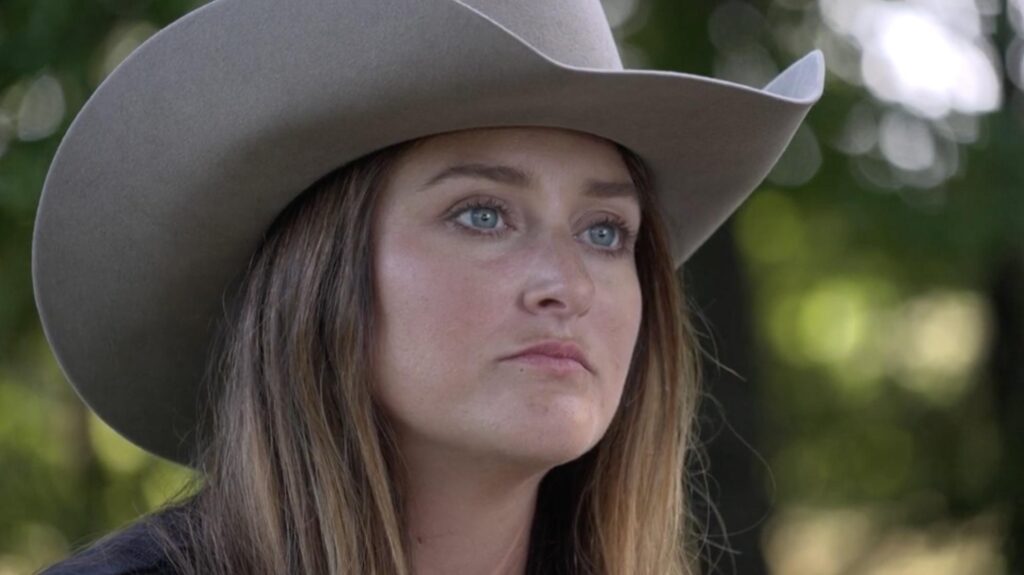
Lt. Dakota Black is a tracker and detective with the Pottawatomie County Sheriff’s Office in Shawnee, Oklahoma, where she works on cases involving missing people, fugitives and violent crime.
Her work brought her national attention through the 48 Hours episode “Tracker Dakota Black,” which follows Black and Detective Marcus May as they investigated the September 2023 disappearance and murder of Makayla Meave.
Black entered the case when Makayla was still considered missing. Within days, she and other investigators came to believe that Makayla’s husband, Frank Byers, had invented a story about his wife leaving with another man.
What followed was a 38-day investigation involving searches, surveillance footage, phone records, forensic testing, interviews, evidence of a cleanup attempt and the discovery of Makayla’s blood on Byers’ work boots.
For Black, the case became more than another investigation.
She later said the cruelty of what happened to Makayla would stay with her for the rest of her life.
- “Tracker Dakota Black”: 48 Hours Reports on Makayla Meave Homicide September 5 2026
- Who Was Makayla Meave & What Happened to Her? 2026 Update & Profile
- Who Is Frank Byers & Where Is He Now? 2026 Update & Profile
Dakota Black Works as a Tracker and Detective
Black works for the Pottawatomie County Sheriff’s Office and has specialised training in tracking.
Her role can require her to locate people who have disappeared into rural areas, people wanted by law enforcement and missing persons who may be alive or dead.
Black told 48 Hours that she had found people in locations ranging from piles of leaves to trees, abandoned homes and sheds.
The work can require traditional investigative skills alongside the ability to interpret terrain and signs left behind by people moving through an area.
That made Black a natural choice when Makayla Meave disappeared from a rural property near Macomb, Oklahoma.
Her Colleagues Know Her as a Tough Investigator
Black’s colleagues have described her as someone capable of holding her own in an office dominated by men.
In the 48 Hours report, fellow officers joked that she was a “cool dude with long hair” and said she could be tougher than many of them on the shooting range and in the field.
The description reflects the reputation Black had developed before the Meave investigation.
Her work involved situations in which officers may need to search difficult terrain, track suspects or spend long periods working outdoors.
The Makayla case would demand another kind of endurance.
It required weeks of investigative work while the community demanded answers and the man detectives suspected remained free.
Black Often Works With a Therapy Dog Named Haven
One of Black’s regular partners is Deputy Haven, a trained therapy dog.
Haven is used to help children, relatives and other people dealing with traumatic events.
The dog provides comfort during investigations where families may be experiencing grief, fear or uncertainty.
During the Makayla case, that relationship took on another meaning.
Black said the investigation affected her mental and emotional health.
Haven, who was often there to comfort other people, became a source of support for Black herself.
Black Was Called When Makayla Meave Disappeared
Makayla was reported missing on September 16, 2023.
Her husband, Frank Byers, told deputies that Makayla had left the previous evening with a bald man driving a white pickup truck.
Deputy Dustin Richardson was one of the first officers to respond.
Richardson became suspicious of Byers’ account after visiting the property, hearing inconsistencies and discovering spent shell casings inside the small residence where Makayla had been staying.
He called for criminal investigators.
Black was one of the detectives brought into the case.
Her first priority was not proving that Byers had done something.
It was finding Makayla.
Black’s First Mission Was to Find Makayla
When Black received the call, she travelled to Macomb.
She later described her immediate objective in simple terms: locate Makayla.
At that point, investigators did not know whether Makayla was alive, injured, hiding or the victim of a crime.
Black worked with Detective Marcus May.
The pair issued a BOLO, or be-on-the-lookout alert, based on Byers’ description of the bald man in the white truck.
Law-enforcement agencies across the surrounding area began watching for possible matches.
Tips arrived.
None produced the man Byers described.
Black Began Doubting Frank Byers’ Story
The more investigators examined Byers’ account, the more problems emerged.
He said Makayla had gone on a date.
Her family said that did not fit her behaviour.
He said they had agreed to an open marriage.
Her relatives rejected that explanation.
He said Makayla had communicated with him after leaving.
Investigators would later discover that her phones remained in his possession.
Black and May began focusing on Byers before Makayla’s body had been found.
They suspected he knew more than he was saying.
Black Interviewed Byers for More Than Two Hours
Three days after Makayla was reported missing, Byers agreed to an interview at the sheriff’s office.
Black questioned him.
The interview lasted about two and a half hours.
She used an approach designed to keep him talking rather than confronting him with every suspicion investigators had developed.
Black acknowledged that people were pointing fingers at him and gave him room to explain his version of events.
Byers repeated the story about Makayla’s date.
He said she had not told him the man’s name or explained how she knew him.
Black eventually allowed him to leave.
There was not enough evidence for the arrest she wanted to make.
Black Refused to Arrest Byers Before the Case Was Ready
One of the defining decisions of the investigation was Black’s refusal to move too early.
She believed Byers was responsible.
Other investigators shared that suspicion.
The community was becoming angry.
But Black knew that arresting someone is not the same as proving a murder case.
If police moved before collecting enough evidence, prosecutors could face problems keeping Byers in custody or obtaining a conviction.
Black said she wanted evidence strong enough to make sure that once he entered jail, he stayed there.
That choice required patience.
It also meant watching a man she believed had murdered his wife remain free for more than a month.
The Community Put Pressure on Investigators
Makayla was well known in the area.
She worked at a local elementary school and had built a reputation for caring about children.
After she disappeared, residents joined the search.
People slogged through mud, rain, woods and brush looking for her.
Flyers appeared across the county.
Social media amplified the case.
With each passing day, frustration increased.
Investigators could not tell the public everything they knew.
May later said one of the hardest parts was knowing evidence was building against Byers but being unable to release it.
Black had to work within that pressure while continuing the investigation.
Black Noticed That Byers Did Not Search for His Wife
One detail stood out to Black.
Byers did not participate in the searches.
Black said he never joined a search party and never volunteered to go out looking for Makayla.
That behaviour did not prove he had killed her.
It added to the detectives’ concerns.
May also described a lack of emotion in Byers’ behaviour.
Investigators expected a husband whose wife had vanished to appear afraid or desperate for answers.
Instead, they said Byers seemed interested in finding out what police knew.
Black continued looking for evidence that could move the case beyond suspicion.
Makayla’s Body Was Found on the Fifth Day
Five days after the disappearance, relatives searching near Hamilton Road detected a strong smell near a ditch.
A searcher followed the smell to a drainage culvert.
A hand was visible.
Makayla’s body was inside.
She had been wrapped in carpet and dragged into the pipe beneath the road.
Her shirt had been pulled over her face.
One of her feet still had a teddy-bear sock.
The discovery hit Black hard.
She later said the scene was difficult to process.
Black Stayed With Makayla at the Crime Scene
Black did not leave Makayla’s side while investigators processed the scene.
Her reaction went beyond the responsibilities of a detective.
She felt a personal connection with the victim.
Black and Makayla had been born one day apart in the same year.
Black also had her own history with troubled relationships.
She told 48 Hours that there had been moments in her own past when she could have suffered a similar fate.
That recognition shaped the way she viewed Makayla.
The victim was not an abstraction.
Black could see parts of her own life reflected in the woman lying in the culvert.
Black Said the Murder Could Have Happened to Her
Black spoke openly about the impact of her own relationship history.
She said she had been in bad relationships and understood how dangerous those situations can become.
When she looked at Makayla’s case, she recognised that the difference between them could have been circumstance.
Black said it could have been her on more than one occasion.
She considered herself fortunate to have survived her own experiences.
That personal history intensified her determination to solve Makayla’s murder.
The case became about evidence and justice, but it also became about a woman Black felt connected to despite never having known her in life.
Black Wanted to Arrest Byers After Makayla Was Found
The discovery of Makayla’s body made Black angry.
She wanted to leave the scene and arrest Byers.
She stopped herself.
Black knew anger could not substitute for probable cause and a prosecutable case.
She chose to continue working.
The decision became a central theme of the 48 Hours episode.
Black was not interested in making the fastest arrest.
She wanted the strongest one.
The next weeks were spent assembling a case piece by piece.
Black Reconstructed the Breakdown of the Marriage
The investigation expanded beyond the crime scene.
Black examined the relationship between Makayla and Byers.
She learned that the marriage had been collapsing.
She found evidence of Byers’ infidelity.
She tracked down women he had contacted.
She discovered that Makayla had moved out of the home they shared and was staying in a separate structure on the same property.
Black also recovered a recording made two days before Makayla’s death.
In it, Makayla told Byers that their marriage was over.
The recording gave investigators context for what happened next.
Black Found Makayla’s Final Security-Camera Images
Home security footage became one of the most important pieces of the timeline.
Investigators recovered images showing Makayla arriving at Byers’ house on September 15.
She entered.
She stayed for about 14 minutes.
Then she left.
The final image showed Byers standing at his doorway.
Black believed Makayla and Byers had been arguing during those 14 minutes.
She developed the theory that Byers then followed Makayla to the separate building where she was staying and killed her within minutes.
Black Believed Makayla Was Shot in Her Small Residence
Investigators found spent shell casings inside Makayla’s residence.
A bullet was later recovered from a wooden beam.
Material believed to be Makayla’s hair was wrapped around the projectile, although investigators could not obtain a genetic confirmation from it.
Makayla had gunshot wounds to the head.
Black reconstructed the shooting as occurring inside the building.
She believed Byers then left Makayla’s body there while he went to collect his daughters.
Hours later, detectives believe, he returned and moved the body.
Black’s task was to turn that reconstruction into evidence.
A Walmart Receipt Led Black to Surveillance Footage
A receipt recovered from the property gave Black another lead.
She used the date and time to obtain Walmart surveillance footage.
The video showed Byers shopping on September 16, the day after investigators believe Makayla was killed.
In his cart were bleach, ammonia and a mop.
Black interpreted the purchase as evidence of a crime-scene cleanup.
The products did not prove murder by themselves.
In context, they became another part of the state’s reconstruction.
Makayla was shot.
Her body was moved.
Byers bought cleaning supplies the next day.
Black Traced the Carpet Used to Wrap Makayla
The carpet found around Makayla’s body was another potential source of evidence.
Investigators learned that a neighbour had given carpet to Byers and Makayla months earlier for their dogs.
The neighbour confirmed the connection.
Black concluded that Byers used that carpet to wrap Makayla’s body before moving her.
The evidence linked an object found at the disposal site back to the property.
Each connection tightened the case.
Black was still waiting for something stronger.
Black Helped Uncover the Phone Manipulation
Makayla’s phones produced another major breakthrough.
Byers had told police that Makayla left with her phone and messaged him afterward.
Investigators found one of her phones in his bedroom.
Makayla had two devices, including an old Moto G.
Detectives concluded that Byers moved her SIM card into the older phone so he could access her accounts.
According to May and Black, Byers then sent messages while pretending to be Makayla.
The electronic evidence undermined his central claim.
The woman he said was communicating after leaving the property was, investigators believed, already dead.
Black Tracked Down Women Connected to Byers
Black also spent significant time investigating Byers’ relationships with other women.
She contacted scores of people.
Those interviews helped detectives understand his pattern of behaviour.
One of the women was Crystal Cantrell, who had dated Byers before Makayla.
Cantrell described him as manipulative and controlling.
She also accused him of violence, including choking her during an incident involving handcuffs.
The information was not the forensic proof Black needed for the murder charge.
It contributed to the broader profile investigators were building of Byers and his relationships.
Black Worked 18-Hour Days on the Case
The investigation consumed Black.
She described working 18-hour days.
She lost weight.
She became exhausted.
The case affected her mental health.
Despite that, she said she did not want to go home until it was solved.
The same determination that made her effective as a tracker carried over into the murder investigation.
The person she was tracking was no longer physically missing.
What Black was trying to find was the evidence that would connect Byers to what investigators believed he had done.
Haven Became a Source of Comfort for Black
During those long days, Black’s therapy dog Haven remained close.
Haven normally accompanied her to provide comfort to victims, children and families.
In the Makayla investigation, Black needed some of that support herself.
The emotional connection between detective and victim had become intense.
Black was dealing with images from the crime scene, the family’s grief and the knowledge that the suspect she believed responsible remained outside jail.
Haven became part of the way she managed that pressure.
The dog appears throughout the 48 Hours episode as both investigative companion and source of comfort.
Black Waited for the Forensic Results
Two pieces of evidence remained at the laboratory.
One involved the projectile recovered from Makayla’s residence.
The other involved Byers’ work boots.
Detectives had seen a suspicious substance on the boots when they were seized.
Because Byers worked around hazardous materials and chemicals, Black could not assume the staining was blood.
She needed laboratory confirmation.
She later described wanting a “smoking gun.”
The case was already substantial.
The lab result would determine when investigators moved.
Makayla’s Blood Was Found on Byers’ Boots
Thirty-eight days after Makayla went missing, the results arrived.
The substance on Byers’ boots was blood.
It belonged to Makayla.
Black said the investigative team moved as soon as they received the confirmation.
The result supplied the physical connection she had been waiting for.
Makayla’s blood was on the boots of the husband who claimed she had left voluntarily with another man.
For Black and May, the waiting period was over.
They had enough to make the arrest.
Black Helped Organise Byers’ Arrest
Black coordinated with a special operations team.
Police moved in close to midnight.
Byers was taken into custody 38 days after Makayla’s disappearance.
He continued saying he had not killed her.
Black was present when the man she had been investigating for more than a month was placed in handcuffs.
May contacted Makayla’s family.
The arrest gave them one form of relief.
The person investigators blamed for Makayla’s death was no longer free.
For Black, the arrest represented the result of her decision to wait for evidence rather than act on anger.
Byers Could Not Explain the Blood
Investigators questioned Byers after his arrest.
May confronted him with the forensic evidence.
Why was Makayla’s blood on his work boots?
Byers said he did not know.
He was charged with first-degree murder.
Prosecutors later announced plans to seek the death penalty.
For Black, the case moved from investigation into prosecution.
Her work had produced the arrest she had wanted since Makayla’s body was found.
The remaining outcome would be decided through the courts.
Byers Pleaded Guilty Instead of Going to Trial
Byers did not face a full murder trial.
Fifteen months after his arrest, he agreed to plead guilty.
The plea removed the death penalty.
He accepted life imprisonment without the possibility of parole.
For Black, the result ensured the central objective she had expressed during the investigation.
Byers would stay in prison.
Makayla’s mother had mixed feelings about the agreement and wanted him to face the death-penalty trial.
The plea nevertheless meant Byers admitted responsibility and would not be released on parole.
Black Did Not Dismiss Questions About an Accomplice
Makayla’s mother and sister have questioned whether Byers moved her body alone.
The physical task involved wrapping Makayla in carpet, loading her into a vehicle, taking her down an embankment and dragging her into the culvert.
Black acknowledged that moving the body would have been difficult.
She also noted that people can perform difficult physical acts under extreme circumstances.
Investigators have not publicly established that another person helped Byers.
They have said they remain willing to follow evidence if it emerges.
The possibility means one part of the Makayla investigation has never been completely closed in the minds of her family.
The Case Became the Focus of a 48 Hours Episode
CBS built the 48 Hours episode around Black because of the way she approached the investigation.
The title “Tracker Dakota Black” places the detective at the centre.
Peter Van Sant follows her through the evidence and explores the emotional connection she formed with Makayla.
The episode shows a type of investigative work that does not end when police identify the most obvious suspect.
Black suspected Byers early.
Her challenge was proving the case.
That required weeks of restraint, interviews, searches, digital evidence and forensic testing.
Black Said the Case Will Stay With Her Forever
Black has investigated other missing-person and criminal cases.
She said Makayla’s murder stands apart.
The reason was the cruelty of what happened and the connection she felt with the victim.
She described it as a case she would remember throughout her life.
Black could see parallels between Makayla’s experience and difficult relationships from her own past.
She also saw the grief inflicted on a family and community.
The professional achievement of solving the case did not erase those memories.
It gave them an outcome.
Dakota Black Became Part of Makayla’s Story
Black never met Makayla while she was alive.
Yet the investigation tied their stories together.
Makayla’s family searched for answers.
Black became one of the people responsible for finding them.
She first searched for Makayla as a missing woman.
Then she stood beside her body in a culvert.
After that, she spent weeks proving who had put her there.
Thirty-eight days after Makayla disappeared, Black helped place Frank Byers under arrest.
His guilty plea later ensured he would spend the rest of his life in prison without parole.
For Black, that did not make the case a victory in the conventional sense.
A woman was still dead.
Children had lost someone who cared for them.
A mother and sister had lost a daughter and best friend.
What Black could give them was accountability.
That is why “Tracker Dakota Black” is as much a profile of the detective as it is the story of the murder she helped solve.
More “Tracker Dakota Black”
- “Tracker Dakota Black”: 48 Hours Reports on Makayla Meave Homicide September 5 2026
- Who Was Makayla Meave & What Happened to Her? 2026 Update & Profile
- Who Is Frank Byers & Where Is He Now? 2026 Update & Profile
- Who Is Tracker Dakota Black & Where Is She Now? 2026 Update & Profile
More Feature Articles
- “The Grudge”: Dateline NBC Revisits the Murder of Daniel Anderl and the Gunman Who Targeted Judge Esther Salas September 4 2026
- “The Hungryland Homicide”: 20/20 Reports on Tricia Todd Homicide September 4 2026
- “The Gaslighting of Hannah Pettey”: 48 Hours Reports September 5 2026
- “Tracker Dakota Black”: 48 Hours Reports on Makayla Meave Homicide September 5 2026