


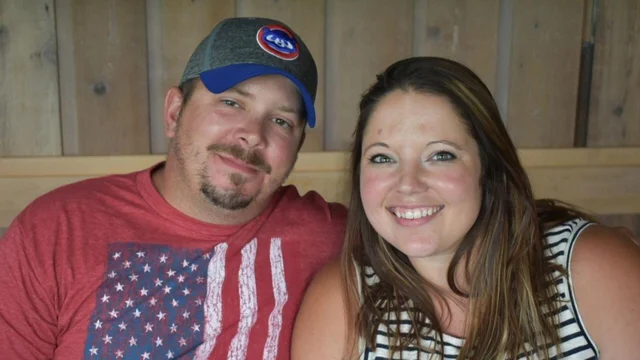
Kevin Davis was 40 years old when he was found critically injured at the bottom of the staircase inside the New Haven, Indiana, home he shared with his wife, Alison Davis.
The circumstances appeared to offer an immediate explanation. Alison said she woke after hearing a loud noise and discovered Kevin face down at the bottom of the stairs in a pool of blood. She called 911 and reported that her husband had fallen.
A detective who entered the house that morning reached much the same conclusion. The scene appeared to be a tragic household accident.
Kevin died from his injuries the next day.
His death, however, did not remain classified in the minds of investigators as a simple fall. Questions about the nature of his head injuries changed the direction of the case, and four months later police arrested Alison and accused her of murdering her husband.
The case reached an Allen County jury in May 2025. Prosecutors argued that Kevin had been beaten with a blunt object. Alison’s attorneys maintained that he suffered his injuries in a fall.
No murder weapon was found. No one witnessed an attack.
After about six hours of deliberations, the jury acquitted Alison.
Kevin’s death therefore sits at the center of a case with a clear legal outcome but a continuing disagreement over the events that caused his fatal injuries.
- “A Death in the Stairwell”: 48 Hours Reports on Kevin Davis & Alison Davis Case August 29 2026
- Who Is Alison Davis & Where Is She Now? 2026 Update & Profile
Kevin and Alison Davis Shared a Life in New Haven
Kevin lived with Alison in New Haven, Indiana, near Fort Wayne.
He was 40 at the time of his death. Alison was 33.
People close to them described a loving relationship. Alison’s father, Steve Krause, remembered the couple calling each other “babe,” while Alison’s best friend, Kasey Klemm, recalled seeing them dance together in their kitchen.
Those memories became important after Kevin’s death because prosecutors would present a far darker theory about what happened between the couple during his final night.
The Davises did not have children together.
Their household included Willow, a black-and-white pit bull mix who occupied an important place in their lives.
Krause described Willow as being like a child to the couple.
The dog would later become an unusual part of the investigation into Kevin’s death.
Kevin and Alison Spent His Final Evening at a Tavern
On August 11, 2023, Kevin and Alison went to a local tavern.
Witnesses who saw them there did not describe an evening marked by a major confrontation.
Friends and tavern employees later told 48 Hours that the couple appeared happy.
Nothing they observed suggested that Kevin would be dead within two days or that Alison would face a murder prosecution.
Kevin and Alison left the tavern at around 1 a.m. and returned home.
What happened after they arrived became the subject of the criminal case.
Alison acknowledged that she and Kevin argued.
Her account was that the disagreement did not turn violent.
Alison Said She and Kevin Slept on Separate Floors
According to Alison, the argument ended with the couple deciding to spend the remainder of the night apart.
Kevin went upstairs to the bedroom.
Alison stayed downstairs and slept on a couch.
Willow was upstairs.
That separation became crucial because Alison said she did not witness whatever happened to Kevin on the staircase.
She could describe what happened before she went to sleep and what she discovered after she woke.
She could not provide an eyewitness account of Kevin’s fall.
That gap would give investigators room to question whether the fall had occurred at all.
A Loud Noise Woke Alison
Alison said she woke after hearing a loud noise inside the house.
She got up to investigate.
She found Kevin at the bottom of the stairs.
He was face down and unresponsive.
There was a large amount of blood.
The scene indicated that Kevin had suffered severe trauma.
Alison called 911.
From the first emergency call, she identified a fall as the explanation.
She told the dispatcher that her husband had fallen down the stairs and that she could not turn him over.
Emergency responders were sent to the house.
Kevin Was Alive When Emergency Crews Arrived
Kevin had suffered catastrophic injuries, but he was still alive.
Paramedics transported him to Parkview Regional Medical Center.
His condition was critical.
At that stage, Alison was not being treated as a murder suspect.
She was the wife of a man believed to have suffered a devastating accident in their home.
Detective James Krueger of the New Haven Police Department began investigating the scene.
Alison gave police permission to search the house.
Krueger entered looking for evidence that might explain what had happened to Kevin.
What he saw initially supported the account Alison had given.
The First Detective at the Scene Thought Kevin Had Fallen
Krueger’s first impression is one of the most important details in the case.
He believed Kevin’s injuries had resulted from a fall.
Alison’s explanation appeared consistent with the scene.
There was no immediate discovery of a weapon or other piece of evidence that transformed the house into an obvious homicide scene.
Krueger later recalled that the circumstances seemed to check out.
That meant the initial police assessment and Alison’s account pointed in the same direction.
Kevin had fallen down the stairs.
There was, however, one part of the house Krueger did not examine.
Police Did Not Search the Upstairs Bedroom
Before police entered the house, Alison warned them about Willow.
The dog was protective of the home and could react to strangers.
Alison expressed concern about what might happen if an officer encountered Willow.
When Krueger approached the upstairs bedroom, he could hear the dog inside.
He opened the door enough to assess Willow’s reaction.
The dog growled and showed her teeth.
Krueger decided not to enter.
Police examined other areas of the home but left the bedroom alone.
At the time, the decision did not appear to threaten an investigation because Krueger believed Kevin had suffered an accident.
Only after the case changed direction did the unsearched room become a source of speculation.
Kevin’s Family Gathered at the Hospital
Kevin remained in critical condition at the hospital.
Alison went to see him.
Her father later recalled watching his daughter speak to her unconscious husband.
She called Kevin “babe” and told him she loved him.
The affectionate name was the same one relatives said the couple had used before his injuries.
Doctors could not save him.
Kevin died on August 13, 2023, one day after he was found at the bottom of the stairs.
He was 40.
Kevin Was an Organ Donor
Kevin’s death also gave other people a chance at life through organ donation.
He was an organ donor, a decision Alison supported.
People close to her remembered that she took pride in what Kevin’s donation could mean for others.
At the time, his death was still being understood as a tragic accident.
Friends mourned him.
Alison became a widow.
Police had not accused her of causing Kevin’s injuries.
Then the medical evidence began to change investigators’ view of what had happened.
Kevin’s Head Injuries Raised Questions
The extent and pattern of Kevin’s injuries became the foundation of the homicide investigation.
There was no dispute that he had suffered severe head trauma.
The dispute concerned its cause.
Could Kevin have received all of those injuries while falling down the staircase?
Or had someone struck him with a blunt object?
Investigators and medical experts began leaning toward the second explanation.
The change was significant.
If Kevin had been beaten, his position at the bottom of the staircase no longer provided an innocent explanation for his death.
It became part of a potential crime scene.
The Autopsy Shifted the Case Toward Homicide
The autopsy forced investigators to reconsider their original conclusion.
Authorities believed Kevin’s injuries showed multiple impacts that were inconsistent with a straightforward accidental fall.
Prosecution expert Dr. Bill Smock later testified that the injuries indicated multiple blows to different areas of Kevin’s head.
His conclusion was that Kevin had been the victim of homicide.
That medical opinion provided investigators with the basis for looking beyond the staircase.
But it created another question.
If Kevin had been beaten to death, what had been used to strike him?
Police Never Found the Object That Supposedly Killed Kevin
Investigators considered several possible weapons.
An exercise weight was one possibility.
A baseball bat was another.
But no object was recovered and established through forensic evidence as the weapon used against Kevin.
There was no blood-covered bat introduced as the murder weapon.
There was no exercise weight conclusively connected to an assault.
There was no object bearing evidence that established Alison had used it to strike her husband.
The missing weapon became a major weakness when the case reached trial.
Prosecutors had a theory that Kevin had suffered blunt-force blows without the blunt object that had caused them.
Police Came to Believe Kevin Had Been Murdered by His Wife
Detective Krueger’s view changed during the months after Kevin’s death.
The officer who had first believed the scene showed an accident came to believe Alison had killed Kevin.
Police developed a theory based in part on the argument Alison admitted having with Kevin after the couple returned from the tavern.
Krueger believed Alison had lost control and beaten her husband.
The state had no eyewitness to support that reconstruction.
No one saw Alison attack Kevin.
No one saw Kevin being struck.
There was no surveillance recording of what happened inside the house.
The prosecution would have to establish its version through circumstantial and medical evidence.
Alison Was Charged With Kevin’s Murder
About four months after Kevin died, authorities arrested Alison.
She was charged with murder.
The arrest transformed Kevin’s death into a public homicide case.
His wife, who had called 911 and told police he fell, was now accused of causing the injuries herself.
Alison pleaded not guilty.
She maintained that she had not attacked Kevin and that her original account was true.
Kevin had fallen.
Because Alison remained in custody awaiting trial, the case would take another severe toll on both families before a jury heard the evidence.
Kevin’s Death Divided People Who Knew Him
The accusation against Alison forced friends and relatives to confront competing versions of Kevin’s final hours.
Some people supported Alison.
They believed the woman they knew was incapable of beating Kevin to death.
Others were less certain.
The medical evidence raised questions they could not answer.
Kevin himself could provide no account.
There was no witness who could describe his movements before he ended up at the bottom of the stairs.
The case became a dispute over evidence left behind by a man who could no longer explain what happened to him.
The Prosecution Said Kevin Was Beaten to Death
At trial in May 2025, prosecutors presented Kevin as a homicide victim.
They argued that his injuries could not be explained by the fall Alison described.
Medical testimony formed the heart of that case.
If jurors accepted that Kevin’s injuries resulted from multiple blows, the staircase explanation became difficult to sustain.
Prosecutors then asked jurors to connect the alleged assault to Alison.
She was inside the house.
She and Kevin had argued.
She was the person who discovered him.
The state contended that those circumstances, combined with the medical evidence, proved murder.
The defense said they did not.
The Defense Said Kevin Fell
Alison’s attorneys, Andrew Baldwin and Max Wiley, presented a different explanation for Kevin’s death.
They maintained that the original account was correct.
Kevin fell down the stairs.
The defense examined the structure of the staircase and the surfaces Kevin could have struck during a fall.
They also challenged the prosecution’s interpretation of the injuries.
A fall down stairs does not necessarily involve a single impact.
A person can strike multiple steps and surrounding surfaces before reaching the bottom.
That gave the defense a mechanism for explaining why Kevin had several injuries without requiring an attacker.
Kevin’s Intoxication Became Part of the Defense Case
The defense also argued that Kevin was intoxicated.
That fact mattered to its reconstruction of the fall.
Alcohol could affect balance, coordination and a person’s ability to navigate stairs.
The defense therefore asked jurors to consider the circumstances as a whole.
Kevin had been drinking.
He went upstairs after an argument.
Alison slept downstairs.
At some point, she heard a loud noise.
Kevin was found at the bottom of the stairs.
For the defense, that sequence provided a plausible explanation without murder.
A Defense Pathologist Challenged the Homicide Finding
The defense called Dr. Ljubisa Dragovic.
His testimony offered jurors an alternative medical interpretation of Kevin’s injuries.
Dragovic explained how the injuries could fit a fall.
One juror later told 48 Hours that the defense expert presented the medical information in a way jurors could understand and that his explanation made sense.
That testimony struck at the central premise of the prosecution.
If qualified medical experts could disagree over whether Kevin had been beaten or fallen, the jury had to decide whether the state could still prove homicide beyond a reasonable doubt.
The absence of a weapon made that task harder.
The Jury Had To Decide What Happened to Kevin
The trial was not only about whether Alison was capable of killing Kevin.
It required jurors to decide whether the prosecution had proved that Kevin had been murdered in the first place.
Both sides agreed on the broad outline.
Kevin and Alison went out.
They returned home.
They argued.
Alison said she slept downstairs while Kevin went upstairs.
Hours later, Kevin was found with fatal injuries at the bottom of the staircase.
Everything turned on what happened between those points.
The prosecution filled the gap with an assault.
The defense filled it with a fall.
Jurors Found Holes in the State’s Theory
The jury deliberated for about six hours.
At least one juror later described the prosecution’s case as having substantial holes.
The state had not produced a murder weapon.
There was no eyewitness to an attack.
The original police assessment had supported an accident.
Medical experts disagreed about the meaning of Kevin’s injuries.
Those weaknesses created reasonable doubt for the jury.
The jurors returned to the courtroom with their decision.
Alison Davis was not guilty.
Alison’s Acquittal Ended the Murder Case
The May 2025 verdict meant Alison could not be convicted of Kevin’s murder in that prosecution.
She had spent 17 months incarcerated before being acquitted.
The verdict did not amount to a jury finding that Kevin fell down the stairs.
Nor did jurors identify another person who attacked him.
Their decision answered the criminal question placed before them.
The state had not proved beyond a reasonable doubt that Alison murdered Kevin.
Alison walked free.
Kevin remained dead, and disagreement over the cause of his injuries continued.
Kevin’s Mother Accepted the Jury’s Decision
Kevin’s mother, Alta Beers, spoke about the case after the trial.
Her concern was that the legal battle not cause people to forget her son.
Kevin’s identity had become buried beneath arguments about Alison, forensic pathology, police work and the staircase.
Beers said she accepted the jury’s decision.
She also continued to refer to Alison as her daughter-in-law.
Her response reflected a complicated reality.
The criminal case had been presented as a conflict between Kevin and Alison.
For their families, the relationships did not fit so neatly into prosecution and defense theories.
Police Still Believe Kevin Was Murdered
The acquittal did not change the opinion of James Krueger, who had become New Haven police chief by the time 48 Hours revisited the case.
Krueger continues to believe Kevin was killed.
He has also reconsidered the bedroom he did not search on the morning Kevin was found.
Krueger has questioned whether Willow’s presence in that room prevented police from finding a weapon.
He has wondered whether Alison placed the dog there for that purpose.
No evidence has established that theory.
Police did not find a weapon in the bedroom that morning because they did not enter it.
The possibility remains speculation rather than a proven fact about Kevin’s death.
Alison’s Family Maintains Kevin Died in an Accident
Alison and her supporters continue to reject the homicide theory.
Her father believes Kevin’s death was an accident.
From that perspective, the case began with the correct conclusion before investigators allowed medical interpretations to lead them toward a murder theory they could not prove.
The defense verdict supports only part of that argument in a legal sense.
It establishes that Alison was not proven guilty.
It does not establish an official reconstruction of Kevin’s final seconds.
That leaves two competing narratives in the public record.
Police believe Kevin was assaulted.
Alison maintains that he fell.
What Happened to Kevin Davis?
The established facts provide the outline of Kevin’s final night.
On August 11, 2023, Kevin and Alison went to a tavern.
They returned to their New Haven home around 1 a.m. and argued.
Alison said she slept downstairs while Kevin went upstairs.
She later reported hearing a loud noise.
Kevin was found face down at the bottom of the stairs with catastrophic head injuries.
He was transported to Parkview Regional Medical Center.
He died the next day.
He was 40 years old.
What remains disputed is how he sustained those injuries.
Was Kevin’s Death an Accident or a Homicide?
There is no single answer accepted by everyone involved in the case.
Police Chief Krueger believes Kevin was murdered.
The prosecution’s medical evidence supported a blunt-force assault theory.
Alison, her family and her defense team maintain that Kevin fell.
Their medical expert provided an explanation for how the staircase could have produced the injuries.
The jury did not have to choose one account as historical fact.
It had to determine whether the state proved Alison committed murder beyond a reasonable doubt.
It concluded that the state had not.
That distinction is central to understanding the case.
It would be inaccurate to state as fact that Alison killed Kevin.
She was acquitted.
It would also go beyond the jury’s verdict to say the trial proved exactly how Kevin fell.
The cause of his injuries remains disputed outside the verdict.
Kevin Davis Became More Than the Man at the Bottom of the Stairs
True-crime coverage can reduce a victim to the circumstances in which that person died.
Kevin became the man found at the bottom of a staircase.
His injuries became exhibits.
His marriage became evidence.
His final argument became a possible motive.
His dog became part of a theory about a missing murder weapon.
His body became the subject of competing medical opinions.
For his family, Kevin was more than those things.
He was a 40-year-old man with a wife, relatives, friends and a life that existed before August 2023.
His mother has said she wants people to remember him rather than allowing the murder prosecution to become his entire identity.
Kevin’s Death Left Two Families With Lasting Consequences
Kevin’s death created consequences far beyond the original scene.
His family lost him.
Alison lost her husband and then spent 17 months incarcerated after being accused of causing his death.
The prosecution divided people who knew them and forced both families through a murder trial.
The acquittal gave Alison her freedom.
It could not return Kevin.
Nor could it provide an explanation that satisfied every person involved.
For investigators who believe homicide occurred, the verdict left the person they suspected free.
For Alison and her supporters, the prosecution represented 17 months of imprisonment for an accident she had described from the first 911 call.
Kevin Davis’ Death Remains at the Heart of “A Death in the Stairwell”
CBS’s 48 Hours episode “A Death in the Stairwell” returns attention to the man whose death started the case.
Kevin Davis was found critically injured at the bottom of his staircase on August 12, 2023.
Police first believed he had fallen.
Medical evidence caused investigators to reconsider.
His wife was charged with murder.
At trial, prosecutors argued that Kevin had been beaten with a blunt object. The defense argued that his injuries resulted from falling down the stairs.
There was no identified murder weapon and no eyewitness to an assault.
After about six hours of deliberations, the jury acquitted Alison Davis.
That verdict closed the murder prosecution without ending the disagreement surrounding Kevin’s death.
Kevin died from catastrophic head injuries after being found at the bottom of the stairs. Whether those injuries came from an accidental fall or an assault remains disputed. What the legal system did determine is that prosecutors failed to prove that Alison Davis murdered him.
CBS’s 48 Hours: “A Death in the Stairwell” airs Saturday, August 29, 2026, at 10/9c, examining Kevin’s final night, the forensic evidence surrounding his death, the investigation that shifted from accident to murder and the trial that ended with his wife acquitted.
More “A Death in the Stairwell”
- “A Death in the Stairwell”: 48 Hours Reports on Kevin Davis & Alison Davis Case August 29 2026
- Who Is Alison Davis & Where Is She Now? 2026 Update & Profile
- Who Was Kevin Davis & What Happened to Him? 2026 Update & Profile
More Feature Articles
- “Evil in Eden”: 20/20 Reports on Cary Stayner, the Yosemite Murders and the Stayner Family’s Story of Horror and Heroism August 28 2026
- “The Other Side of Paradise”: Dateline NBC Revisits Sandra Galas Homicide August 28 2026
- “A Death in the Stairwell”: 48 Hours Reports on Kevin Davis & Alison Davis Case August 29 2026
- 60 Minutes Reports on “The Cap Arcona” & “Presenting the Kanneh-Masons” on August 30 2026